
 Français
 Español
 Deutsch
 English
LED Basketball Court Lighting: Lux, Uniformity and Photometric Study
For a basketball court, performance does not depend solely on the number of luminaires. Illuminance, uniformity, layout, visual comfort, glare and installed power must all be considered together.
STADÉLUM Approach
Light the Game, Not Just the Sports Hall Floor
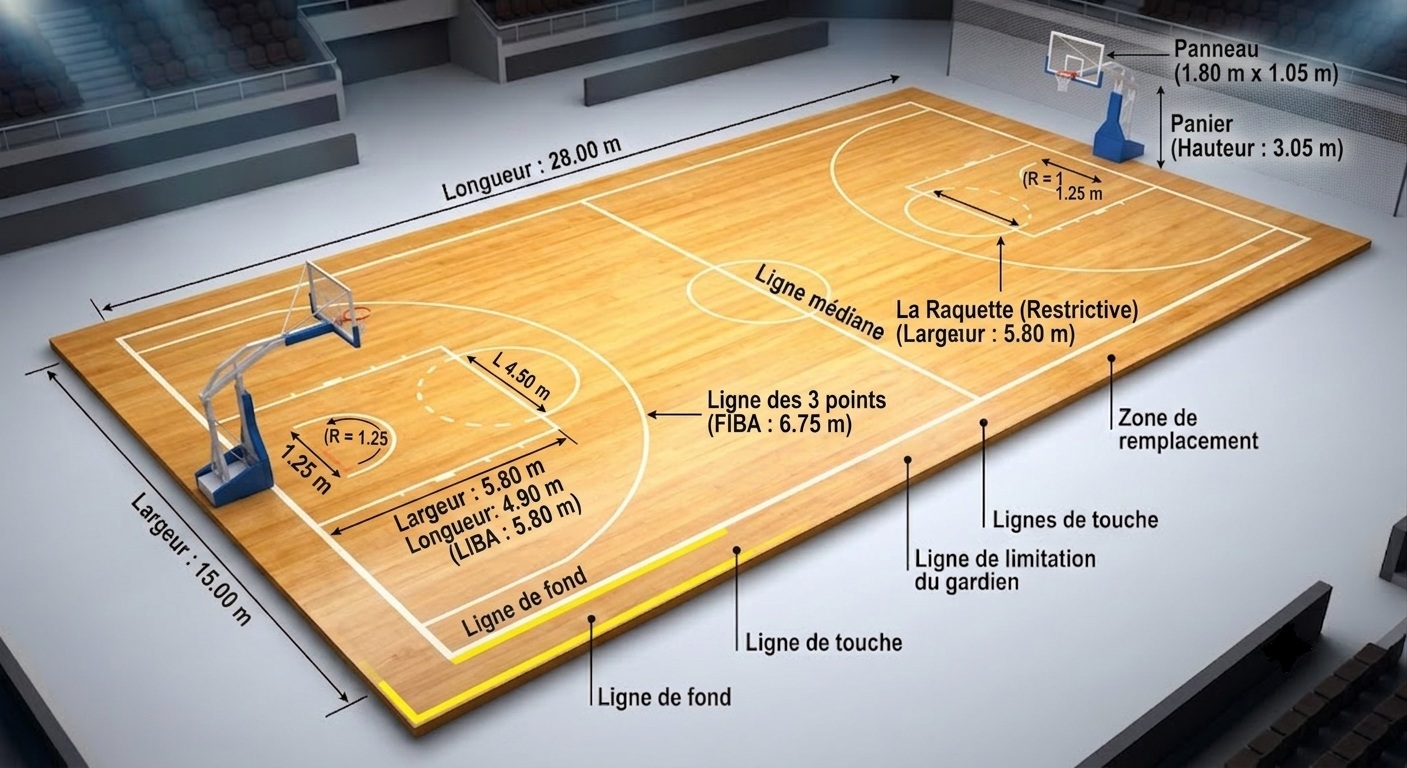
A regulation basketball court measures 28 × 15 m. However, calculations cannot be limited to these dimensions: hall height, baskets, roof structure, stands, fixing points, other sports markings and operating scenarios all influence the choice of installation.
STADÉLUM therefore starts with the actual geometry of the hall before selecting a luminaire. The aim is to achieve the required lux level with uniform distribution, without creating poorly lit areas beneath the baskets or unnecessarily placing light sources in the players' field of vision.
1. Analyse the Hall
Court Dimensions and Installation Constraints
The FFBB uses a reference playing area of 28 × 15 m. Depending on the hall classification, the dimensions of the activity area and the clear height may also determine the configuration.
2. FFBB Regulations 2026/2027
What Illuminance Levels Should Be Targeted for Indoor Basketball?
The FFBB 2026/2027 regulations now distinguish between S1 to S5 classifications. They refer to NF EN 12193 and set minimum illuminance requirements for each federal classification.
| FFBB Classification | Average Horizontal Illuminance Level | Uniformity Emin / Eavg | Measurement Points |
|---|---|---|---|
| S1 | 200 lux permitted for existing facilities · 300 lux strongly recommended | ≥ 0.60 | 13 |
| S2 | 300 lux existing facility · 500 lux new facility | ≥ 0.70 | 13 |
| S3 | 500 lux | ≥ 0.70 | 13 |
| S4 | 750 lux | ≥ 0.70 | 13 |
| S5 | 750 lux | ≥ 0.70 | 13 |
These values are used to define the project target. They do not replace verification of the hall classification, the level of play hosted and any additional requirements, particularly in the case of television recording or broadcasting.
View the FFBB regulations — sports facilities3. Illuminance Measurement
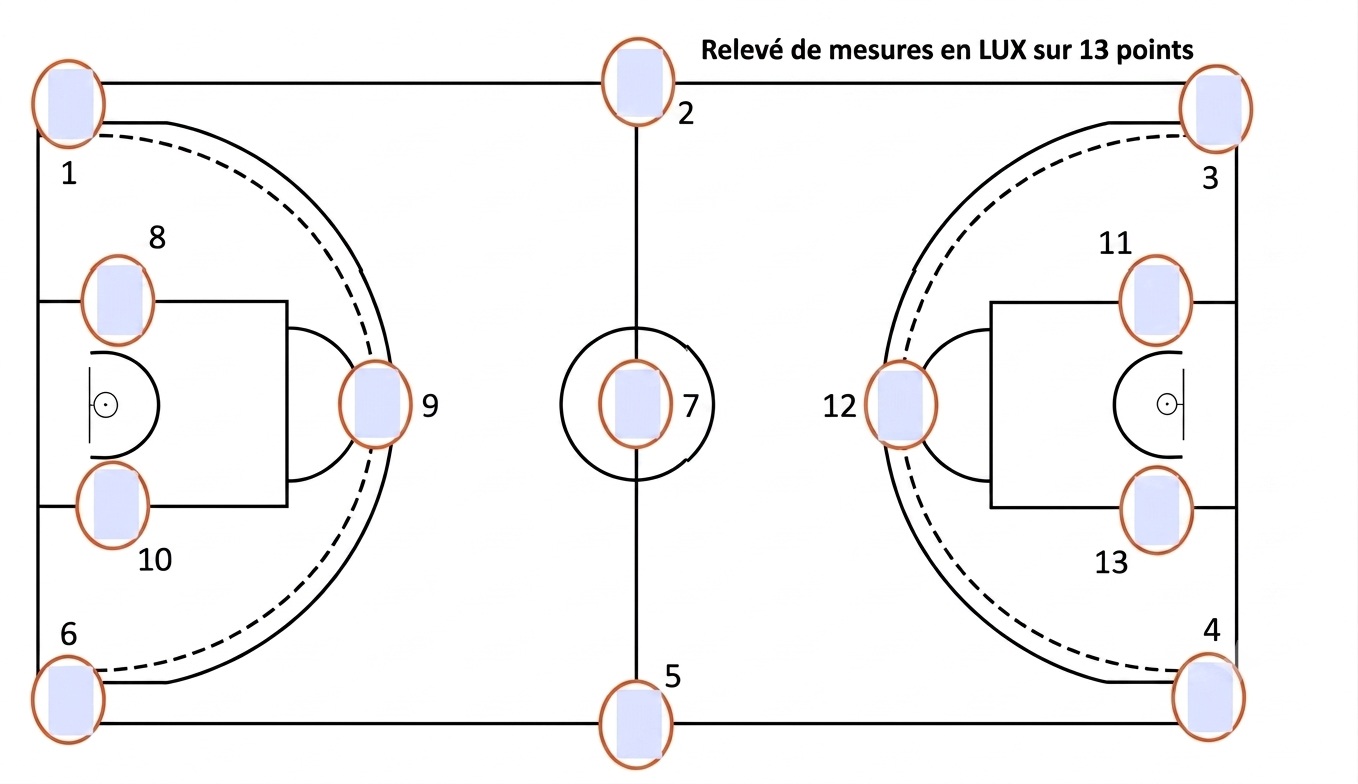
The FFBB Method Is Based on 13 Measurement Points
The FFBB regulations calculate average horizontal illuminance using 13 points at floor level. The main uniformity ratio is obtained by dividing minimum illuminance by average illuminance.
4. STADÉLUM Simulation Example
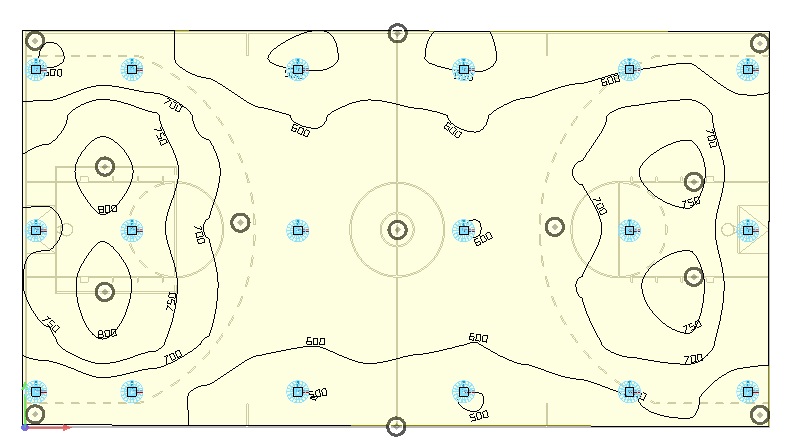
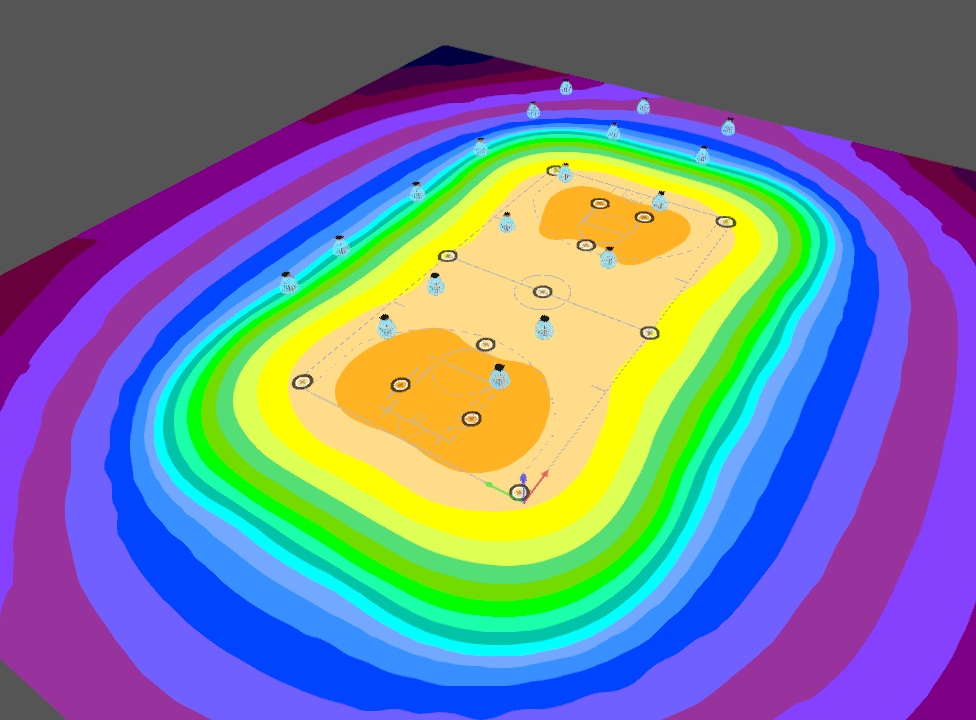
Photometric Study Targeting a Configuration Around 500 Lux
The supplied study illustrates a basketball configuration calculated using a 13-point grid. The figures below are photometric simulation results, not measurements taken after installation.
5. STADÉLUM Method
What the Study Must Check Before Selecting the Luminaires
Hall Geometry
Height, roof structure, stands, baskets and available fixing points.
Layout
Number of luminaires, spacing, positions and sensitive areas beneath the baskets.
Lux and Uniformity
Eavg, Emin and U0 according to the required classification and project specifications.
Visual Comfort
Orientation, glare and visibility for players, referees and spectators.
Installed Power
Optimising the number and power of luminaires without compromising uniformity.
Control and Scenarios
Training, competition, switch-off or dimming depending on the electrical installation.
6. Solutions According to the Configuration
SUPRALED as the Sports Hall Reference, SMASH or COURTLINE for Certain Projects
Luminaire selection must remain the result of the study. The three products below are not designed for the same type of installation.
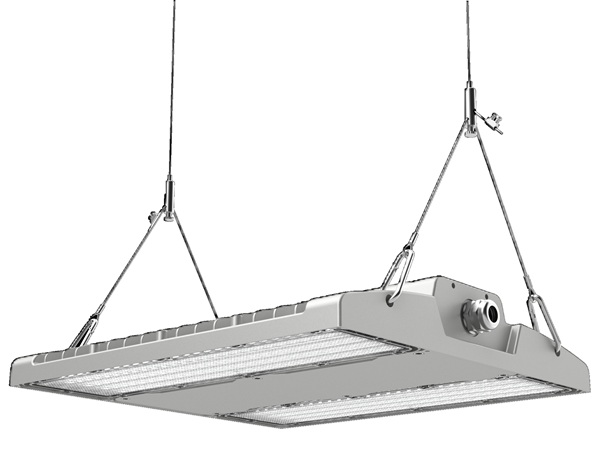
SUPRALED
Designed for sports halls, multi-sport facilities and indoor courts, particularly for basketball and handball. 150 W and 300 W versions, DALI control, IP66 and IK10.
The technical data sheet states compliance with DIN 18032-3 and DIN 57710-13 standards relating to ball impact resistance.
View SUPRALED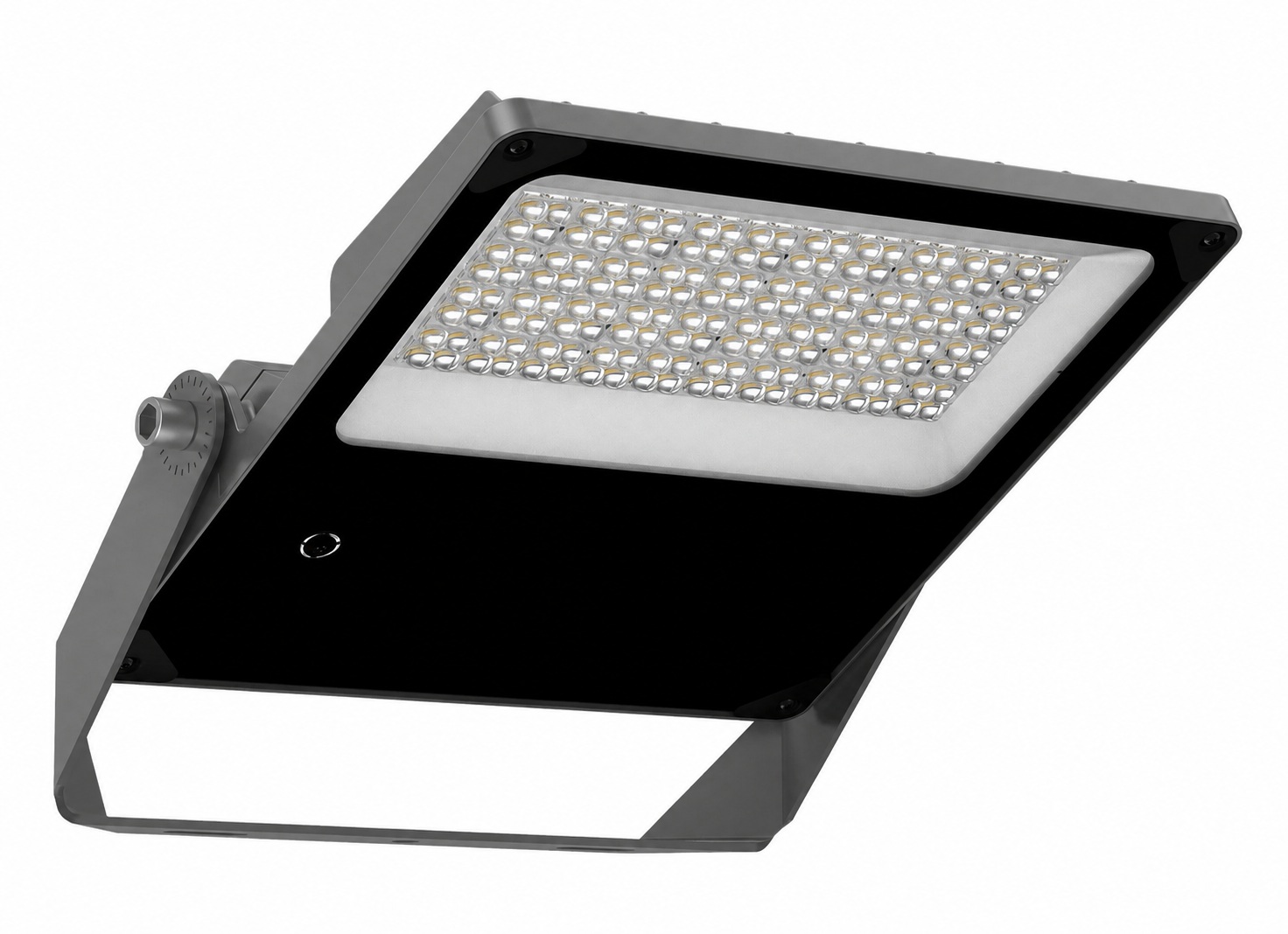
SMASH
300 W or 500 W sports floodlight designed for indoor or outdoor sports facilities. It can be considered for certain sports hall layouts when the geometry requires adjustable light sources.
For indoor basketball use, compatibility with mechanical ball-impact requirements must be confirmed according to the floodlight position and project specifications.
View SMASH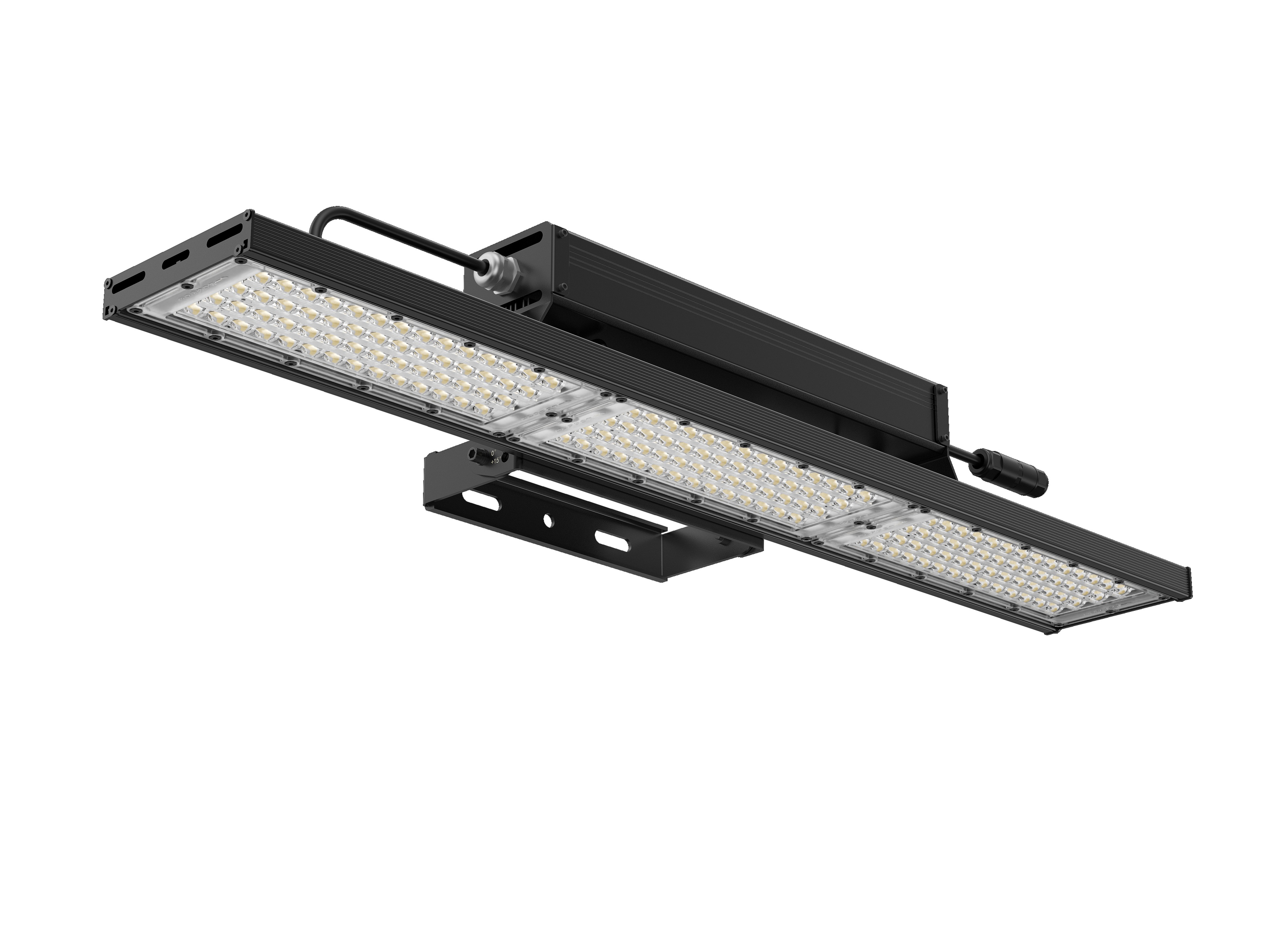
COURTLINE
240 W or 320 W linear luminaire originally documented for tennis and padel. Its shape and optics may justify comparison in certain indoor structures where fixing points are highly constrained.
This is not the default basketball solution: application, photometric performance and mechanical compatibility must be specifically validated for the project.
View COURTLINE7. Sports Hall Lighting Control
Adapt the Lighting to the Hall's Actual Use
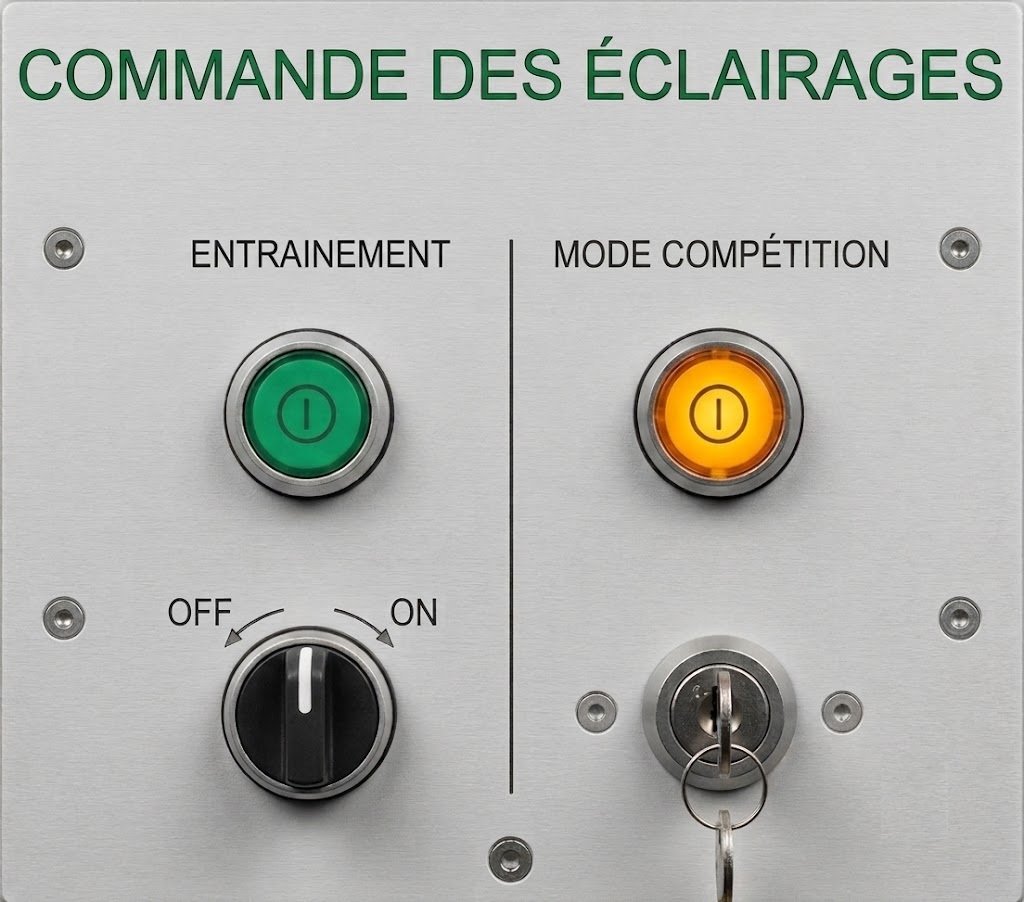
With SUPRALED, DALI control makes it possible to consider several scenarios when supported by the electrical installation and control cabinet. The target level must be defined according to the actual lighting requirement, rather than using an arbitrary dimming percentage.
Completed Projects
View Our Sports Hall Lighting Projects
Sports hall projects provide real examples of challenges involving height, layout, renovation, uniformity and installed power in multi-sport facilities.
Discover our sports hall projectsFAQ
Frequently Asked Questions About LED Basketball Court Lighting
How many lux are required for a basketball court?
The FFBB 2026/2027 regulations specify different levels depending on the hall classification: in particular, 500 lux for S2 in new facilities and for S3, then 750 lux for S4 and S5.
How is uniformity measured?
The FFBB uses a 13-point grid. For S2 to S5 classifications, the Emin / Eavg ratio must be at least 0.70.
Is SUPRALED suitable for basketball?
Yes. Its technical data sheet positions it for sports halls, multi-sport facilities and indoor basketball courts. The layout must nevertheless be designed according to height, lux, uniformity and visual comfort.
Can SMASH be used in a basketball sports hall?
SMASH can be considered for certain indoor sports geometries. For basketball, however, photometric performance, floodlight positioning and mechanical resistance requirements related to its location in the hall must be confirmed.
Can COURTLINE be used for a basketball project?
COURTLINE is not presented as the reference basketball solution. It can only be compared in certain specific configurations where its linear geometry and the available fixing points are relevant. The photometric study and mechanical compatibility must then be confirmed.
Is a photometric study enough to prove the actual result?
No. The study simulates performance before installation. An on-site lux meter measurement is a separate step, carried out after installation when included in the project.
Basketball or Multi-Sport Hall Project?
Study the Hall Before Finalising the Number of Luminaires
Send us the plans, height, available fixing points, photos of the hall, the required classification or level of play and control requirements.
Request a technical preliminary study