
 Français
 Español
 Deutsch
 English
Indoor LED sports lighting · Badminton
LED Lighting for a Badminton Court: Lux, Uniformity and Layout
The shuttlecock travels high, changes direction rapidly and must remain visible against backgrounds that can sometimes be visually complex. In badminton, luminaire positioning and glare control are therefore just as important as the average lux level.
Badminton-specific requirements
The key issue: seeing the shuttlecock without looking directly at the light sources
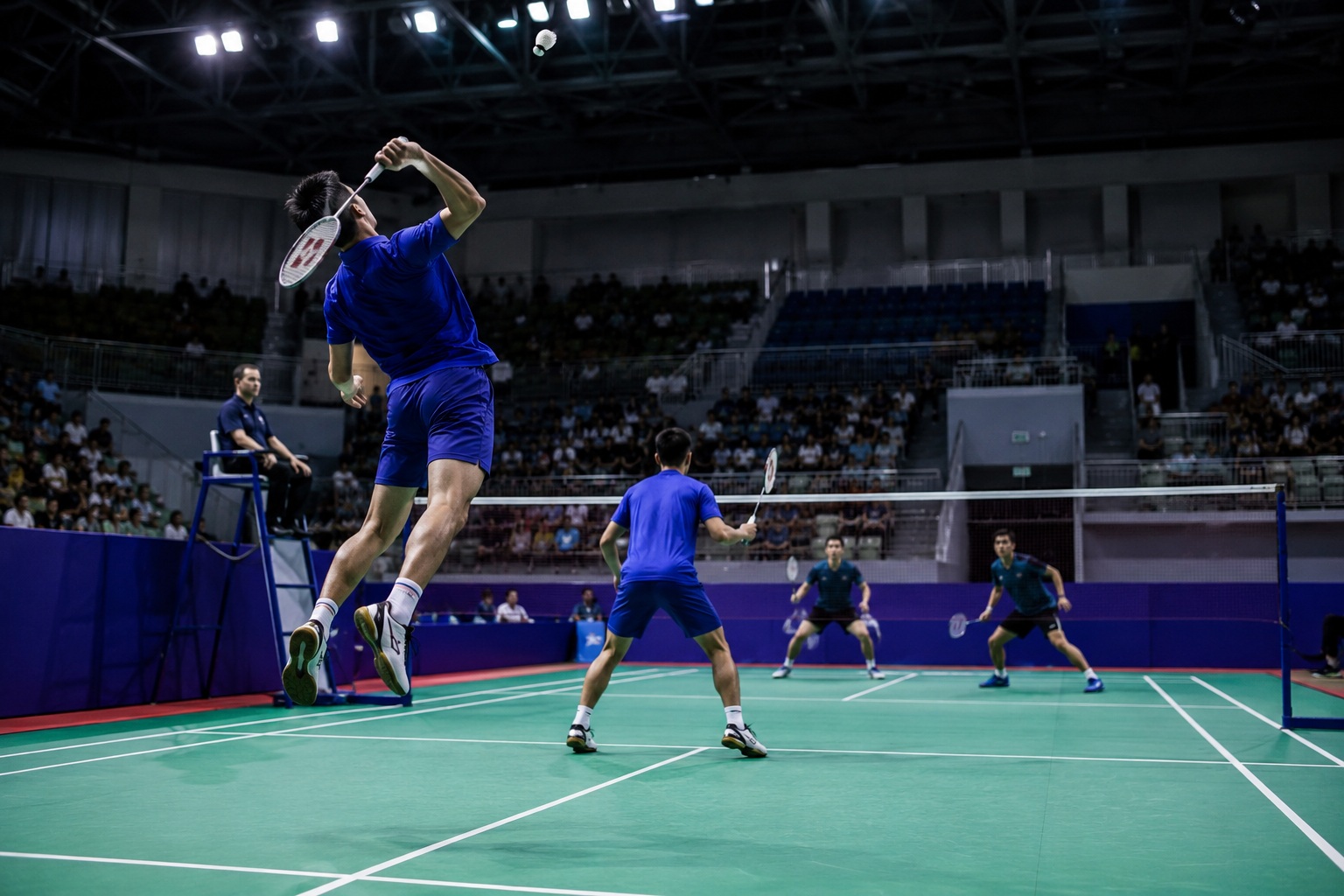
Badminton involves much higher trajectories than most indoor sports. Players regularly look upwards and must track a small white shuttlecock moving at very high speed. Lighting that is too overhead or poorly aimed can therefore become uncomfortable, even if the average lux level appears sufficient.
STADÉLUM approaches the project through the geometry of the hall: number of courts, clear height, roof structure, mounting points, luminaire positions, wall colours, natural light and multi-sport uses. The photometric study then makes it possible to compare layouts and optics.
1. Court geometry
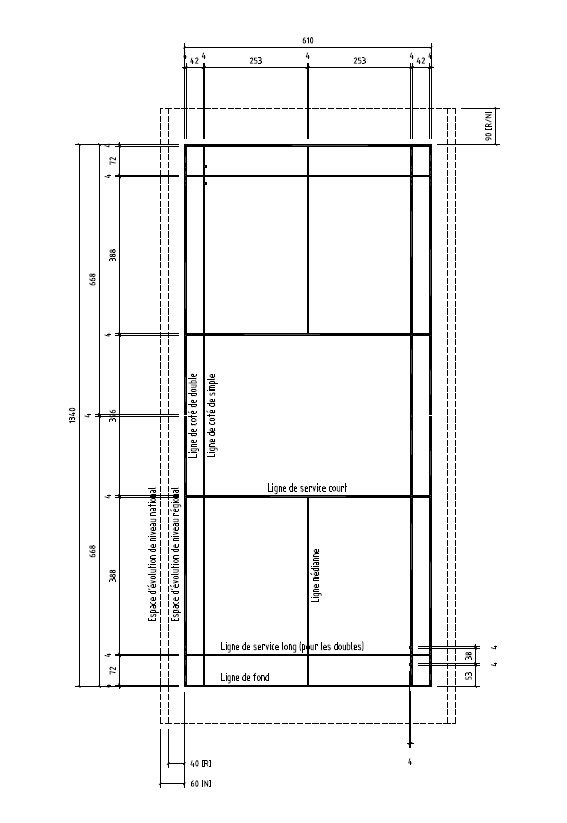
13.40 × 6.10 m, but the study must include the playing clearance
A doubles court measures 13.40 m long by 6.10 m wide. For regional and national competitions, the 2025 reference guide specifies a clear height of 9 m, free from any obstacle.
2. FFBaD 2025 reference values
300, 500 or 750 lux depending on how the hall is used
The FFBaD Technical Quality Reference Guide, May 2025 edition, distinguishes three levels for artificial lighting: training, regional and national.
Reference value indicated for training use.
Level indicated for regional classification.
Level indicated for national classification.
The specifications for the relevant competition must be checked before defining a target.
3. Measurement and uniformity
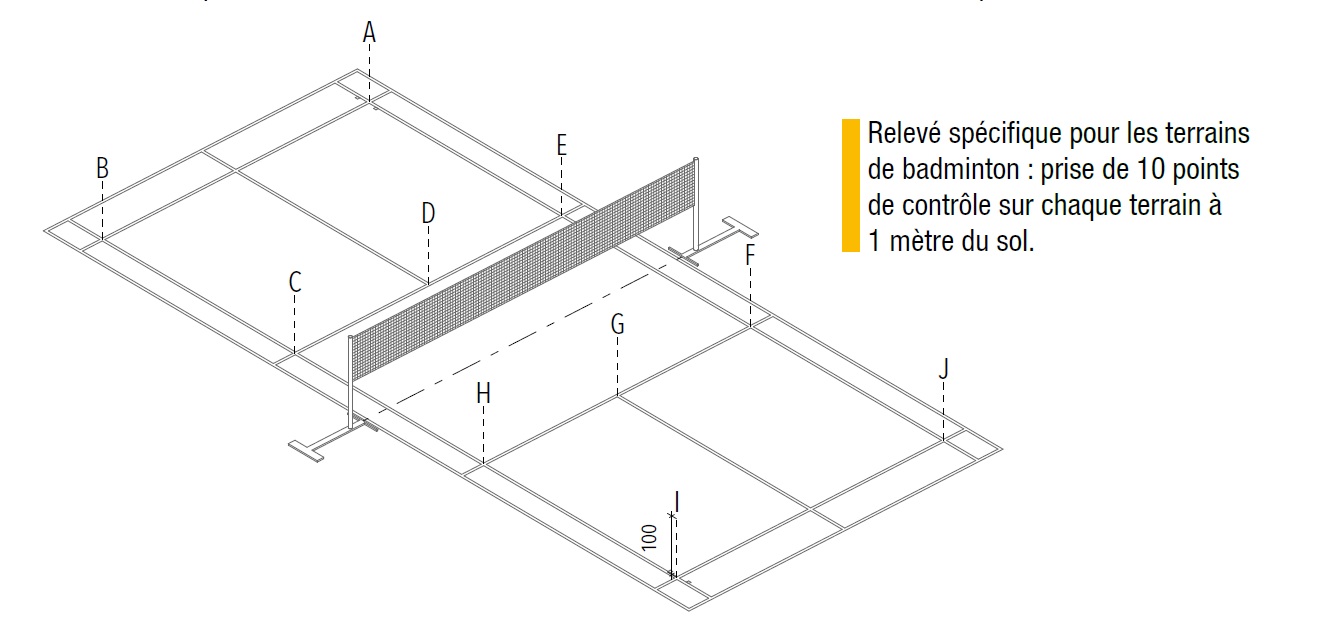
The 2025 reference guide defines 10 measurement points per court
The latest federal document specifies a dedicated measurement using 10 measurement points per court at 1 m above the floor. This grid is used to calculate the average, minimum, maximum and uniformity.
4. Luminaire layout
No luminaires above the court: position them between the courts
This is the most distinctive aspect of a badminton lighting project. The 2025 reference guide maintains the recommendation against positioning luminaires above playing areas and updates the previous approach based on asymmetric floodlights: with LED technology, it encourages the use of lighting rows between the courts, arranged longitudinally.
Light sources outside the playing area
Lighting rows are positioned between the courts or laterally depending on the geometry of the sports hall.
Light distribution
The optic must direct light onto the court from outside the playing area without creating a dark zone in the centre.
Glare
Players' lines of sight and the high trajectories of the shuttlecock must be considered when aiming the luminaires.
Lighting volume
The reference guide emphasises lighting at height, particularly to allow players to follow the shuttlecock's trajectory.
The 2010 document provided recommended side-mounted asymmetric floodlights. The FFBaD 2025 reference guide explains that the development of LED technology now favours lighting rows positioned between the courts along the longitudinal axis. The choice between COURTLINE / SMASH / SUPRALED should therefore be based on this layout, rather than solely on whether the optic is “asymmetric”.
5. Solutions to consider
COURTLINE, SMASH or SUPRALED depending on the geometry and layout
STADÉLUM does not yet have a published badminton project using these products. Their use is therefore presented as a solution to consider. COURTLINE naturally fits a linear lighting approach between the courts; SMASH provides greater aiming flexibility; SUPRALED can also be compared in a multi-sport hall if it is positioned between the courts, outside the playing area. In all three cases, validation requires photometric simulation, glare control and consideration of the building's mechanical constraints.
COURTLINE
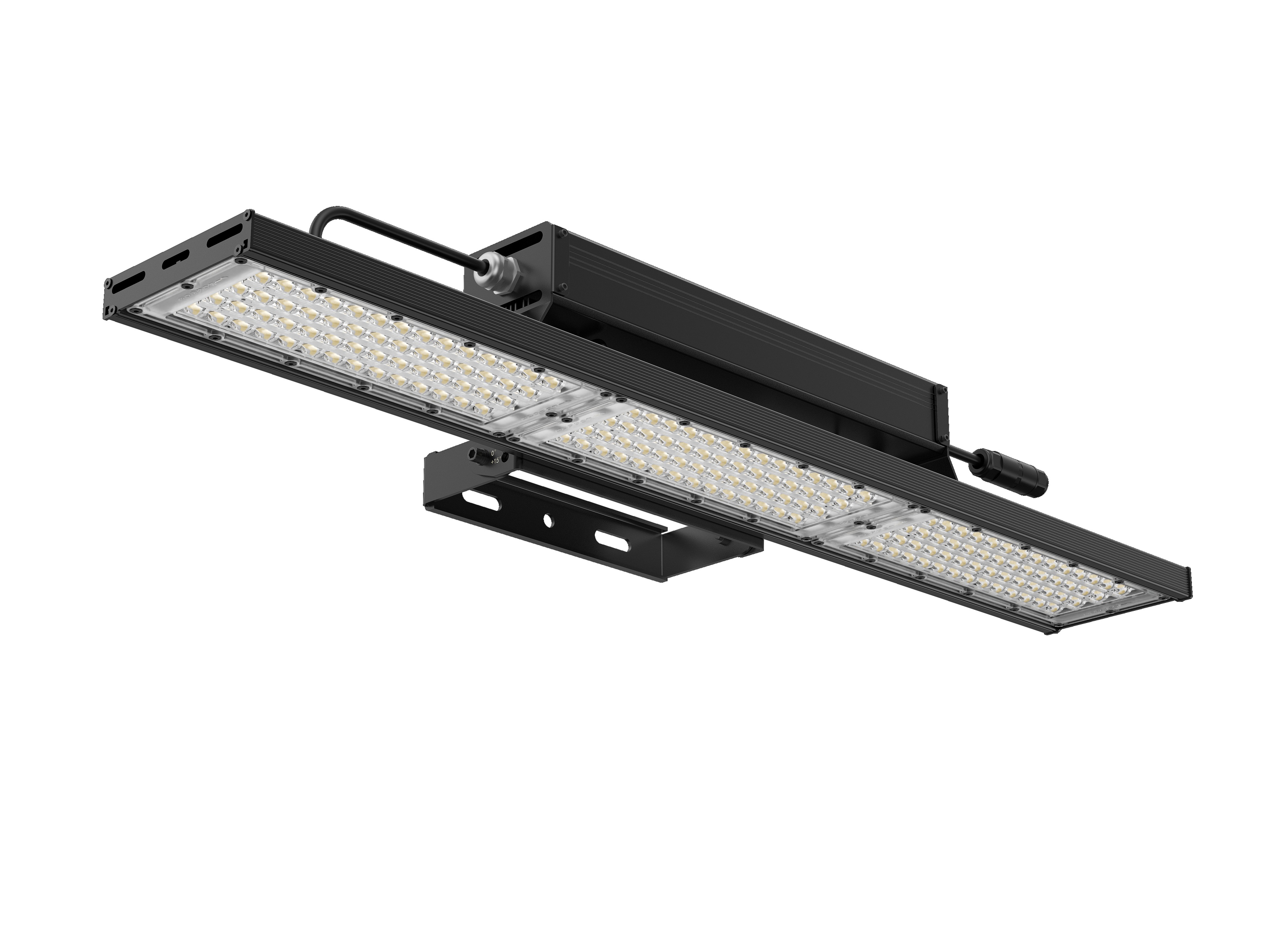
Its linear design fits well with the lighting rows between courts described in the FFBaD 2025 reference guide. The technical data sheet documents a 110° × 60° optic, ±15° tilt, two power ratings of 240 and 320 W and an integrated DALI driver.
Badminton use is not currently claimed on the product page: the configuration must be validated by a study.
View COURTLINE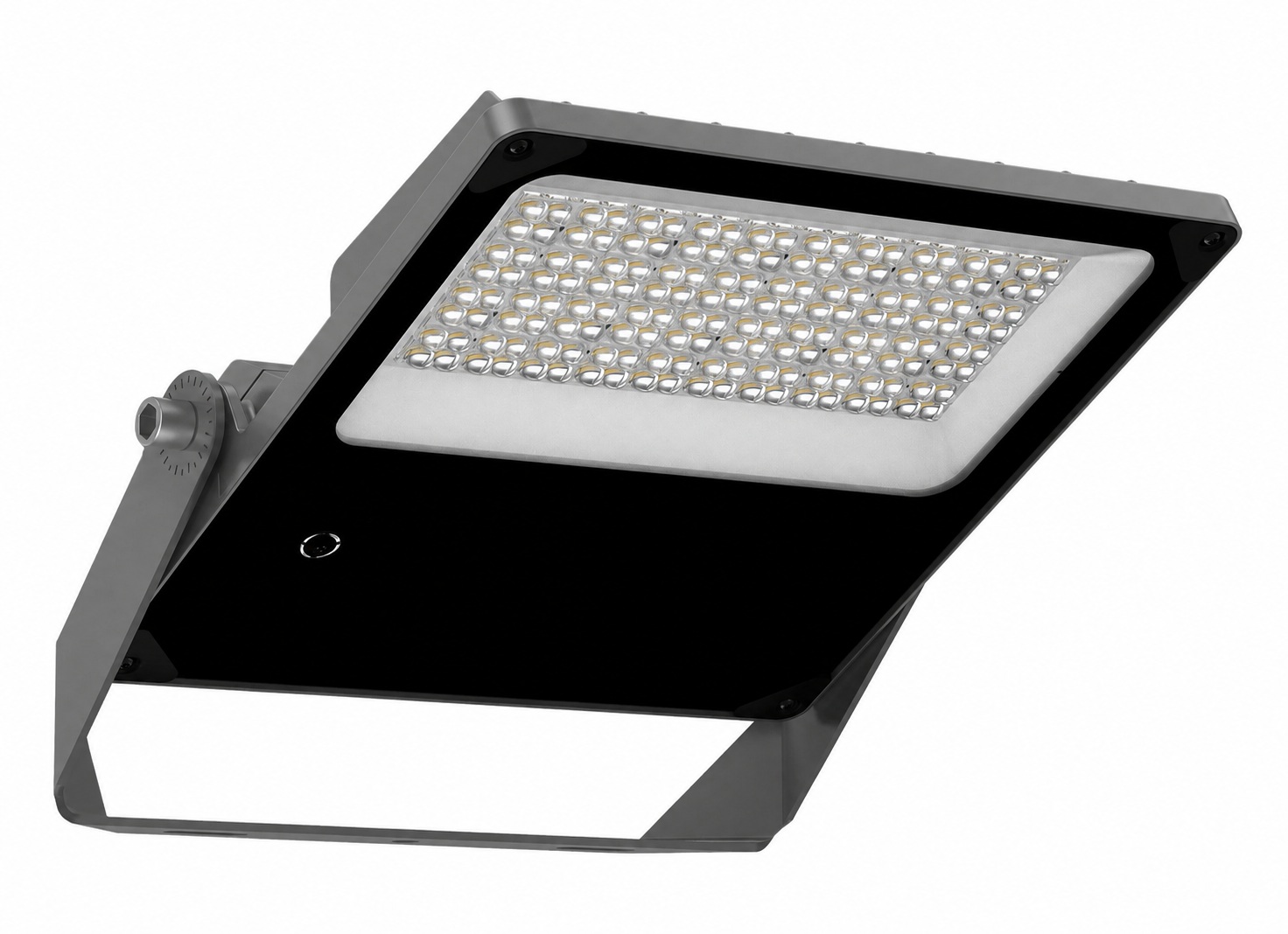
SMASH
SMASH can be considered when a side-mounted, wall-mounted or crossbar installation requires an adjustable floodlight. Its technical data sheet documents a 110° × 60° optic, two power ratings of 300 and 500 W and an adjustable mounting system.
Badminton use must be confirmed through photometric calculations, visual comfort and the mechanical compatibility of the mounting point.
View SMASH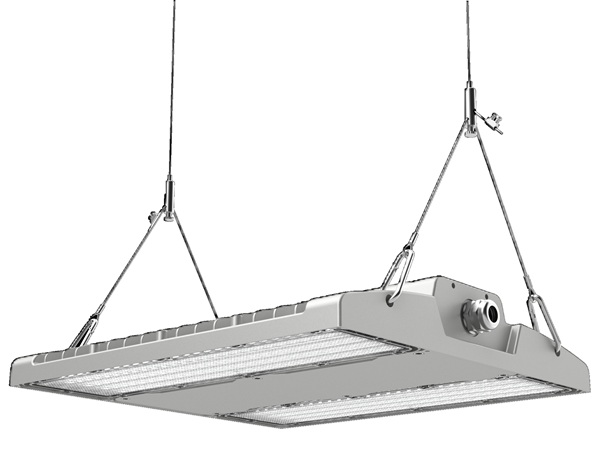
SUPRALED
SUPRALED is designed for gyms and multi-sport halls. In a badminton project, it can be considered between the courts, outside the playing area, when the roof structure allows a layout compatible with FFBaD recommendations.
Its optic is wider and less directional than COURTLINE or SMASH: positioning between courts, mounting height and any required tilt must therefore be checked by calculation. Badminton use is not claimed as a dedicated application on the current product page.
View SUPRALED6. STADÉLUM method
Before choosing the number of floodlights, model the entire hall
Analyse the site
Number of courts, dimensions, height, roof structure, windows, colours and other sports equipment.
Define the target
Training, regional, national or competition-specific requirements.
Create the measurement grid
Include the 10 measurement points at 1 m and check each court on the site.
Compare optics
Test lateral or longitudinal distribution before finalising the product and power.
Check visual discomfort
Examine players' lines of sight, high trajectories and glare.
Optimise power
Compare the number of luminaires, lux, uniformity and installed power before preparing the quotation.
7. Lighting management
Create scenarios suited to training and competition
A badminton hall does not always need to operate at maximum lighting level. Suitable management can make it possible to differentiate between training, competition, switch-off or court zones, when the luminaires and electrical installation allow it.
STADÉLUM projects
View our gym lighting projects
STADÉLUM does not present a dedicated badminton project here. Our gym projects nevertheless provide examples of our method on real sports facilities: building study, layout, luminaire selection, installed power and measured results when available.
View gym lighting projectsFAQ
Frequently asked questions about LED badminton lighting
How many lux are required for a badminton court?
The FFBaD 2025 reference guide indicates 300 lux for training, 500 lux at regional level and 750 lux at national level. International level must be checked against the specific competition requirements.
Is there a specific measurement-point grid for badminton?
Yes. The FFBaD 2025 reference guide specifies 10 measurement points per court, measured at 1 m above the floor. This requirement was not stated as clearly in the previous 2010 document provided.
What uniformity should be targeted?
The reference guide requires an Emin / Eavg ratio greater than 0.70. It also indicates an Emin / Emax ratio greater than or equal to 0.50 in order to limit differences between areas.
Can luminaires be installed above the courts?
The FFBaD reference guide states that this type of layout should be avoided. With LED technology, it favours lighting rows positioned between the courts in the longitudinal direction to illuminate the playing areas without causing glare.
Should asymmetric floodlights still be preferred?
The 2010 technical regulations recommended them. The 2025 reference guide updates this approach: it places greater emphasis on LED lighting rows between the courts. The optic should therefore be selected according to the actual layout.
COURTLINE, SMASH or SUPRALED: which solution should be selected?
COURTLINE is interesting to consider for a linear layout between the courts. SMASH may suit certain side-mounted or crossbar layouts requiring greater aiming flexibility. SUPRALED can also be compared in a gym when the roof structure allows it to be positioned between the courts, outside the playing area. All three solutions must be validated by badminton photometric simulation.
Can several courts be controlled separately?
Zoning can be considered when the electrical architecture and drivers allow it. It can be useful in a dedicated or multi-sport hall to avoid unnecessarily lighting all courts.
Badminton or multi-sport hall project?
Study the layout before choosing the floodlights
Send us the number of courts, the dimensions of the sports area, clear height, roof structure plans, mounting points, photos of the hall and the required level of use. STADÉLUM can then compare layouts and optics before finalising the number and power of the luminaires.
Request a technical preliminary study