
 Français
 Español
 Deutsch
 English
STADÉLUM · TENNIS · RENOVATION
Tennis Lighting Renovation: Switch to LED Without Starting from Scratch
Existing poles, mounting points, wiring or structures can sometimes be retained. However, the photometric design must be recalculated with the new luminaires to verify illuminance levels, uniformity and visual comfort.
The Starting Point
Replace the Old Lighting Without Reproducing Its Weaknesses
An LED renovation should not be treated as a simple “floodlight-for-floodlight” replacement.
Older sodium, metal-halide or other lighting technologies had their own light distribution. An LED luminaire installed in exactly the same position may distribute light very differently.
The first question is therefore not: “What LED wattage replaces my old floodlight?” but rather: “Which solution can achieve the required result from the mounting positions already available?”
Existing Installation Assessment
What Can Be Retained?
The purpose of a renovation is to retain what can reasonably be reused without forcing the project into a layout that is no longer suitable.
Their position, height, condition and ability to support the new equipment must be checked.
Retaining them can reduce installation work, provided their position remains compatible with the photometric design.
Existing circuits can sometimes be reused, subject to electrical compatibility.
It must be tested in the photometric study rather than automatically considered optimal.
STADÉLUM Method
Renovating Based on the Court's Actual Constraints
Assess the Existing Installation
Court dimensions, height, luminaire positions, mounting type, existing power and site photos.
Define the Lighting Target
Level of play, target illuminance, uniformity, visual comfort and specific constraints.
Recalculate the Photometrics
The new optics are simulated using the actual available positions.
Adjust the Product and Power
Power is determined by the photometric requirements: it is not selected through a simple equivalence with the old equipment.
Check Uniformity and Glare
Average lux alone is not enough: the least illuminated areas and player comfort also matter.
Prepare the Aiming
The orientations defined in the study should be reproduced as accurately as possible during installation.
Two Configurations
Indoor or Outdoor Renovation
Indoor
- height below the roof structure
- existing mounting points
- wiring to be retained where possible
- reflections and ball visibility
- uniformity across the entire playing area
- glare along players' lines of sight
Outdoor
- height and condition of the poles
- number of floodlights per support
- setback from the court
- aiming angles
- surrounding properties and spill light
- wind load of the new equipment
Before Ordering the Luminaires
Verify the Existing Layout Through Calculation
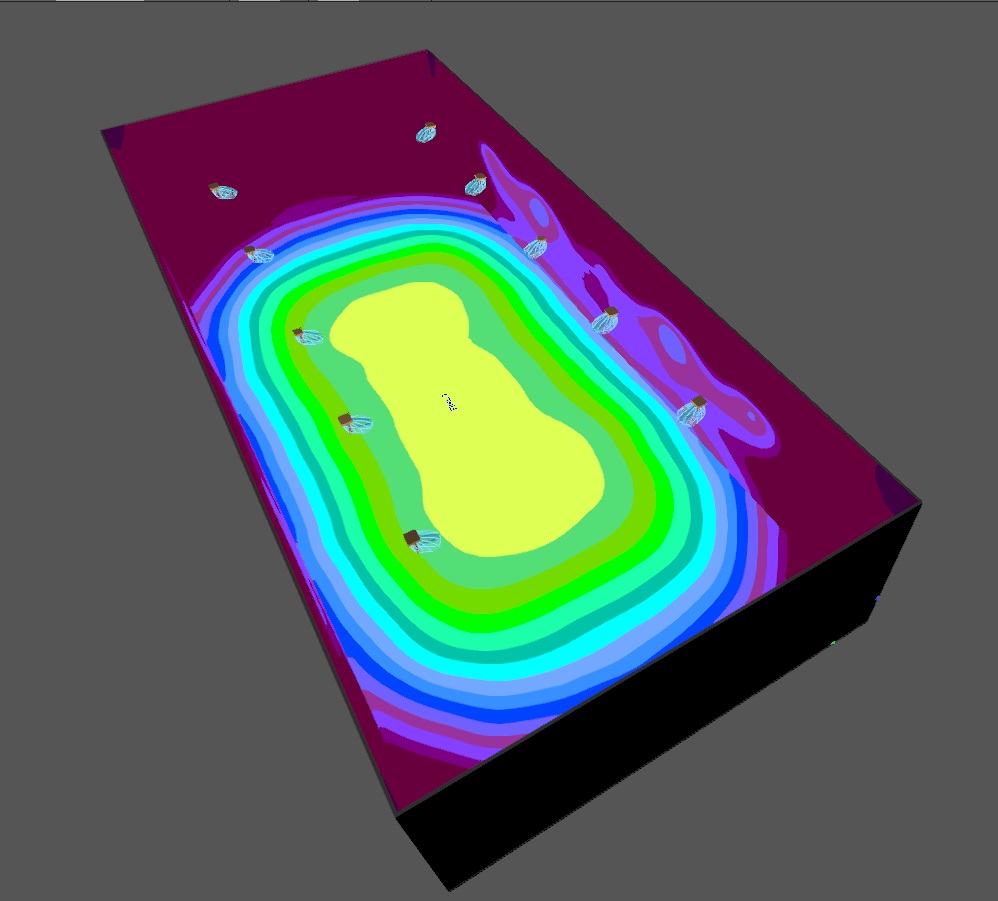
A photometric study makes it possible to test different powers, optics and aiming angles without physically modifying the installation.
This is particularly useful in renovation projects: the existing positions can first be simulated to identify any potential limitations.
 STADÉLUM PROJECT
Real Project · Cestas
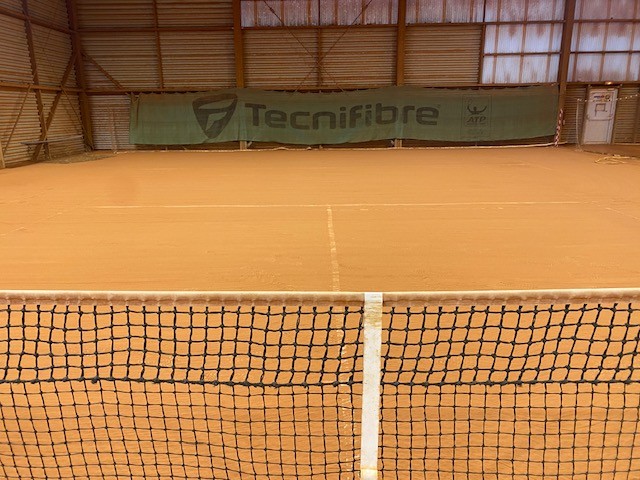
Replacing the Existing Sodium Floodlights While Retaining Their Positions
In Cestas, the renovation involved an existing indoor lighting installation equipped with sodium floodlights.
One of the key objectives was to retain the existing mounting positions to avoid major modifications to the wiring. The solution was studied using SMASH 300 W LED floodlights in 4000 K.
No on-site lux measurements are published here: this project primarily illustrates how the LED solution was adapted to the existing installation constraints.
Example Solution
SMASH: A Solution Suitable for Certain Renovation Projects
SMASH can be used for indoor or outdoor tennis projects depending on the layout studied.
The 300 W version used in Cestas is available in 4000 K or 5000 K with a stated 110° × 60° light distribution.
The final choice of luminaire, power and optics must remain linked to the site study.
Common Mistakes
What a Renovation Project Should Avoid
Power alone cannot determine light distribution across the court.
New optics often require new aiming orientations.
A good Eavg can hide poorly lit areas and inadequate uniformity.
A better layout or optic can be more effective than oversizing.
FAQ
Frequently Asked Questions About Tennis Lighting Renovation
Can Existing Poles or Mounting Points Be Retained?
Yes, when their condition, height and position are compatible with the new solution. The photometric study determines whether these positions can be retained without compromising the result.
What LED Wattage Replaces an Existing Sodium Floodlight?
There is no universal equivalence. Light output, optics, height and layout must all be taken into account. The system should therefore be sized according to the required lighting result.
Does All the Wiring Need to Be Replaced During an LED Renovation?
Not necessarily. Depending on the condition and compatibility of the electrical installation, some existing circuits may be retained. This assessment must, however, be carried out by the installer responsible for the project.
Is a Photometric Study Useful if the Floodlights Remain in the Same Positions?
Yes, precisely because a new technology and new optics do not distribute light in the same way as the previous equipment.
Can Uniformity Be Improved Without Adding More Floodlights?
In some cases, selecting the right optics and adjusting the aiming can improve light distribution. In others, the existing layout creates limitations that must be identified before work begins.
TENNIS RENOVATION PRELIMINARY STUDY
Before Replacing the Existing Floodlights, Let's Check What the Existing Installation Can Really Achieve
Send us the court dimensions, support heights, current luminaire positions, their power ratings, a few photos and the required level of use.
Request a Preliminary Study