
 Français
 Español
 Deutsch
 English
Rugby Pitch Lighting: E1 to E4 Levels, Lux, Uniformity and Mast Layout
For a rugby pitch, successful LED lighting depends on mast positioning, the choice of optics, glare control and the targeted sporting level. STADÉLUM supports the project through site analysis, photometric simulation, optimisation of installed power, floodlight selection and management of operating scenarios.
Overview: Rugby Requires a Complete Lighting Study
A rugby pitch has a large playing area, in-goal areas, distant touchlines, high ball trajectories and fast-moving play. The lighting project therefore cannot be reduced to floodlight power alone: average lux, uniformity, aiming angles, glare, mast height, spill light and control requirements must all be checked.
STADÉLUM acts as a technical partner: site analysis, layout, optics selection, simulation, energy optimisation, assistance with aiming and preparation of the information required for classification or inspection when the sporting level requires it.
Two References to Distinguish
- E1 and E2: this page is based on the LNR Stadium Label levels for professional competitions.
- E3, E4 and training: this page is based on the recommendations of the French Rugby Federation.
- Actual project: the specifications of the club, owner, broadcaster or competition may require additional checks.
1. Rugby Pitch Dimensions
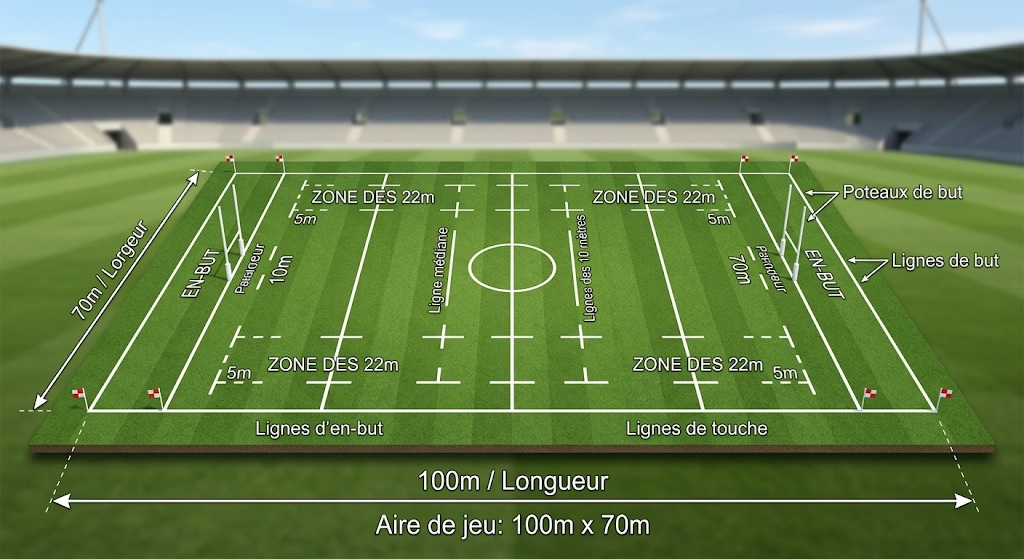
The French Rugby Federation states that the field of play must not exceed 100 m in length and 70 m in width. In-goal areas are generally between 10 and 22 m deep. For certain categories or existing configurations, minimum dimensions may be as low as 89 × 60 m, depending on the classification level and site constraints.
2. Rugby Lighting Regulations and Illuminance Levels
Levels E1 to E4 provide a framework for the project according to the level of competition. E1 and E2 levels are presented on the basis of the LNR reference framework for professional stadiums. E3, E4 and training levels are based on FFR guidelines. Average illuminance must be considered together with uniformity, glare rating, colour rendering and, for high-level competition, the vertical illuminance required for broadcasting.
| Level | Use | Source | EhAvg at commissioning | EhAvg to maintain / inspection | U1h Emin / Emax |
U2h Emin / Eavg |
GR | Vertical / broadcasting | CRI |
|---|---|---|---|---|---|---|---|---|---|
| E1 | International competitions / TOP 14 | LNR | To be designed with a maintenance factor | 1800 lux | ≥ 0.50 | ≥ 0.70 | ≤ 50 | Ev min / Ev avg ≥ 0.60 Ev min / Ev max ≥ 0.40 |
≥ 65 |
| E2 | PRO D2 / National | LNR | To be designed with a maintenance factor | 1400 lux | ≥ 0.50 | ≥ 0.70 | ≤ 50 | Ev min / Ev avg ≥ 0.60 Ev min / Ev max ≥ 0.40 |
≥ 65 |
| E3 | Federal competitions, final stages, Elite women's divisions | FFR | 300 lux | 250 lux | To be confirmed according to project | ≥ 0.70 | ≤ 50 | Not systematically required unless specifically requested | ≥ 65 |
| E4 | Other competitions | FFR | 200 lux | 150 lux | To be confirmed according to project | ≥ 0.70 | To be checked if required | Not systematically required unless specifically requested | ≥ 65 |
| Training | Club use / sports grounds / reduced scenario | FFR / specifications | To be defined according to use. An E4-classified pitch can provide a basis and then be controlled using a reduced lighting scenario for training. | — | Target to be defined | — | — | ≥ 65 recommended | |
3. Measurements and Control Points
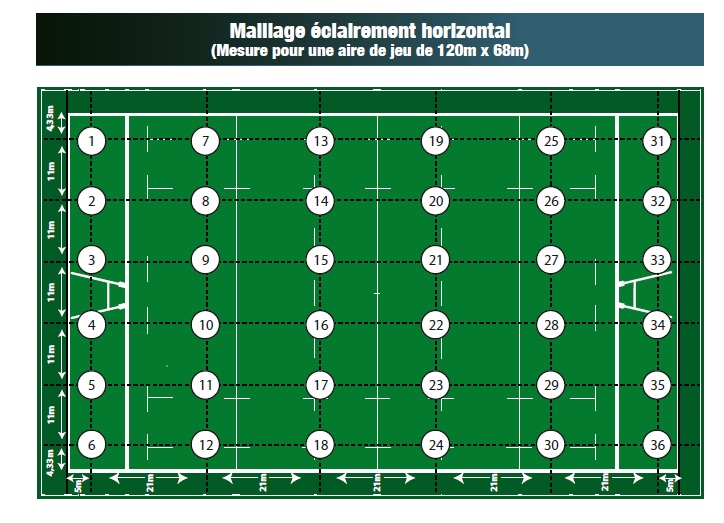
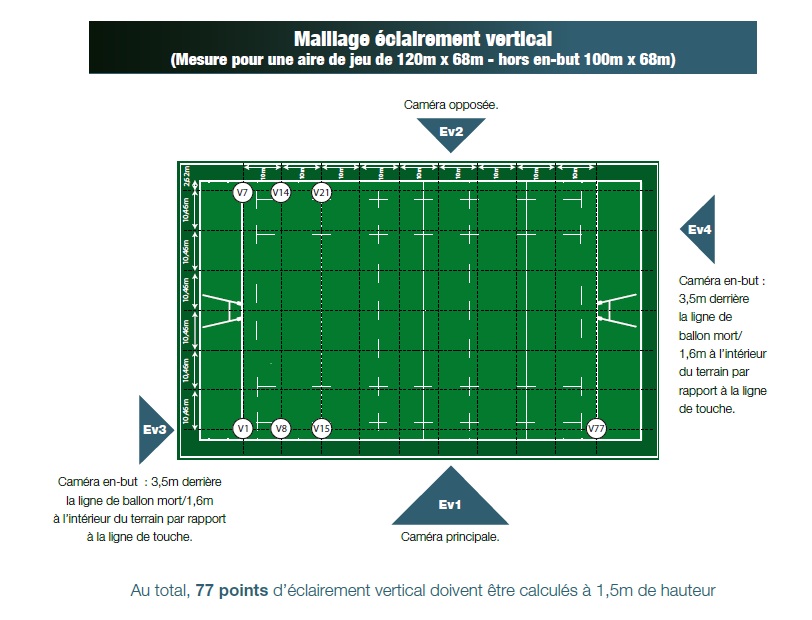
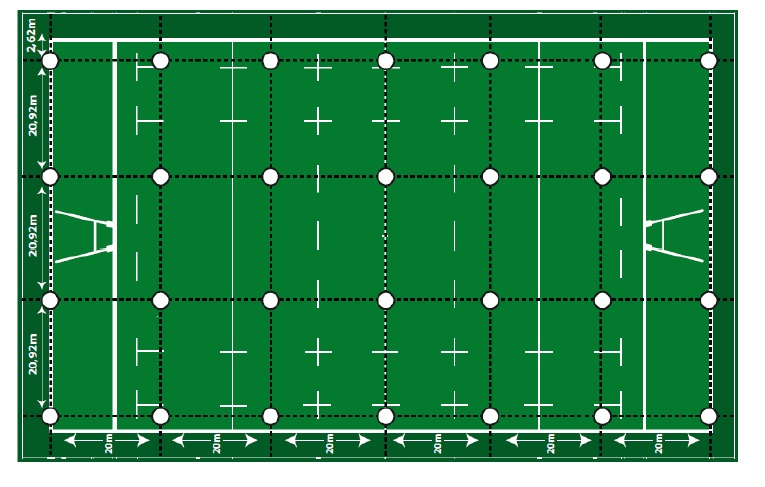
Lighting levels are checked using measurement or calculation points. The grid is not the same for professional stadiums and federal levels: the higher the level, the more the assessment includes television requirements, vertical illuminance and glare.
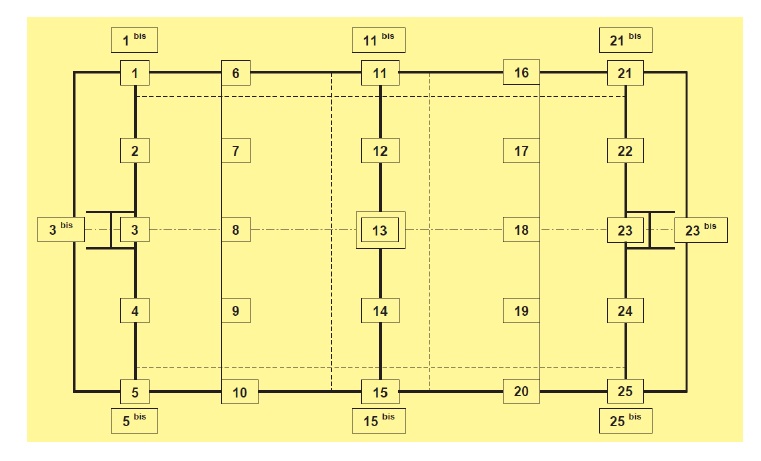
Key Points
4. Mast Layout and Aiming Rules
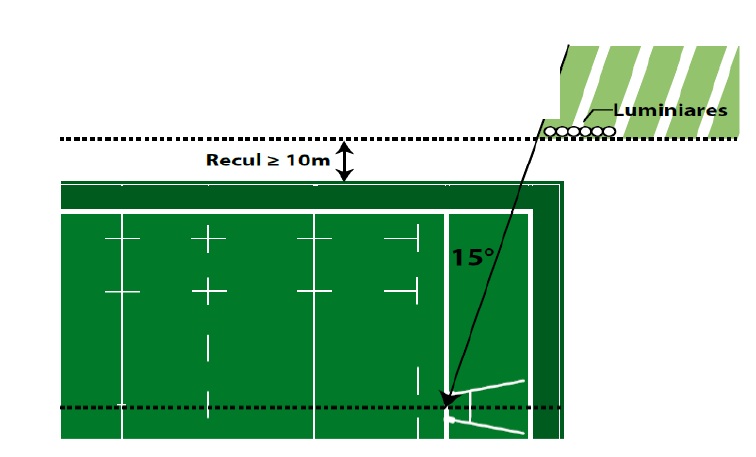
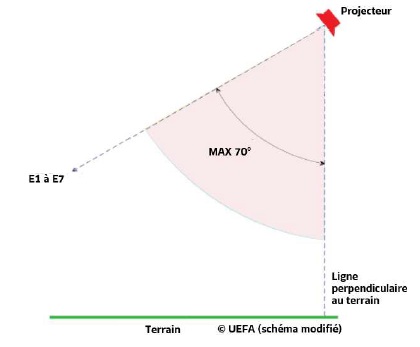
Floodlight positioning must limit glare for players, keep playing areas safe and prevent the lighting line from being too close to the pitch. For rugby, masts must be studied with a setback of at least 10 m, a minimum height of 20 m, controlled aiming angles and particular attention to the in-goal areas.
Layout 1 · 4 Longitudinal Masts
2 masts positioned on each side along the length of the pitch.
Layout 2 · 6 Longitudinal Masts
3 masts distributed on each side along the length of the pitch to improve uniformity.
Layout 3 · 4 High Corner Masts
4 masts positioned at the outer corners, requiring careful study to prevent glare.
Which Mast Should Be Used for a Rugby Lighting Project?
On a rugby pitch, the support structure is part of the lighting design. Height, number of floodlights at the top of the mast, their weight, projected surface area, crossarms, wind conditions and maintenance possibilities must be studied together with the photometric design. STADÉLUM can therefore match the calculated layout with a mast family suited to the project.
SKY / CLIMB
Two mast families to consider for high-level sports installations. The choice of model depends on the configuration, loads, top equipment and mechanical constraints of the site.
View SKY / CLIMB mastsSTADIUM 12 / 16 Sides
Polygonal mast families designed for high-mast sports projects. Selection must be based on the actual planned loads, head type, wind conditions and layout defined by the study.
View STADIUM mastsChanging the height or position of a mast changes the projection distances, aiming angles and light distribution. The combination of mast + crossarm + floodlights + optics must therefore be validated as a complete system, particularly before finalising foundations, loads or total installed power.
5. Example of a STADÉLUM Layout for E4 Level
The example below is a study configuration for an E4 target. It is not a measured installation: the results come from the supplied calculation file and must be recalculated for each actual site according to dimensions, masts, optics, environment and the selected maintenance factor.
Studied Configuration
- Longitudinal layout with 6 × 20 m masts.
- 2 central masts: 2 ARENA STADIUM 1800 W floodlights per mast.
- 4 other masts: 2 × 1500 W floodlights + 1 × 1800 W floodlight per mast.
- Total: 8 × 1800 W floodlights and 8 × 1500 W floodlights.
- Installed power: 26.4 kW.
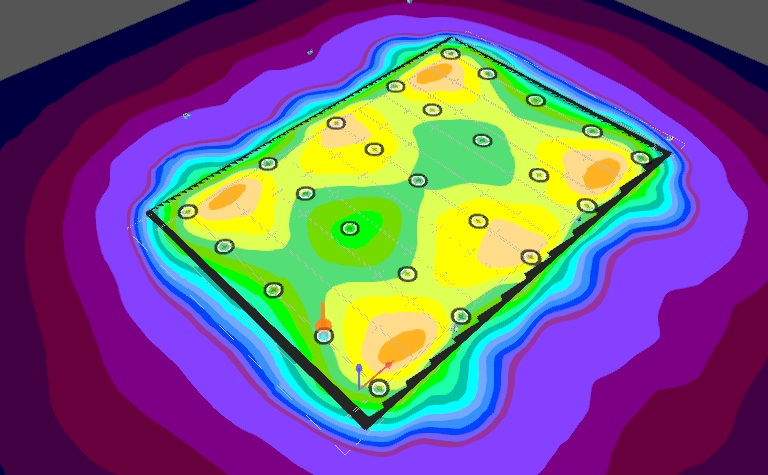
View the 25 calculation points
| Point | Value |
|---|---|
| 1 | 279 lux |
| 2 | 252 lux |
| 3 | 214 lux |
| 4 | 266 lux |
| 5 | 266 lux |
| 6 | 251 lux |
| 7 | 279 lux |
| 8 | 205 lux |
| 9 | 263 lux |
| 10 | 249 lux |
| 11 | 339 lux |
| 12 | 312 lux |
| 13 | 258 lux |
| 14 | 317 lux |
| 15 | 326 lux |
| 16 | 269 lux |
| 17 | 275 lux |
| 18 | 247 lux |
| 19 | 288 lux |
| 20 | 292 lux |
| 21 | 264 lux |
| 22 | 257 lux |
| 23 | 210 lux |
| 24 | 250 lux |
| 25 | 249 lux |
Calculated Summary
The average obtained from the calculation is 267 lux. The lowest point is 205 lux and the highest point is 339 lux. U2h uniformity is therefore rounded to 0.77, meeting the U2h ≥ 0.70 target for E4 level in this study example.
6. ARENA STADIUM Floodlight
ARENA STADIUM is designed for outdoor sports pitches, stadiums and large sports facilities. For a rugby pitch, it allows power, optics, visual comfort, glare limitation and overall layout consistency to be optimised.

7. DALI Control, Timer and Lighting Scenarios
As ARENA STADIUM luminaires are DALI-compatible, a project can include several control scenarios adapted to pitch use: training, competition, switch-off or dimming. The control system can also be combined with a timer to schedule operating periods according to the club's timetable.
- Training scenario: reduced power when the maximum lighting level is not required.
- Competition scenario: activation of the level corresponding to the targeted classification.
- Timer: scheduling of switch-on, switch-off or dimming periods.
- Switch-off: lighting switched off outside operating periods to reduce energy consumption and light pollution.
- Validation: the strategy must be confirmed together with the electrical study, wiring and site operation requirements.
See Also Our Football Lighting Projects and High-Mast Solutions
Rugby lighting shares several challenges with football pitches: high mast heights, glare limitation, uniformity control, assessment of surrounding areas and optimisation of installed power.
View football lighting projectsFAQ — LED Rugby Pitch Lighting
How many lux are required to light a rugby pitch?
The required level depends on the targeted competition. As a working basis, professional E1 and E2 levels may target 1800 lux and 1400 lux according to the LNR reference framework. FFR E3 and E4 levels respectively indicate 300 lux at commissioning / 250 lux to maintain, then 200 lux at commissioning / 150 lux to maintain.
Why is uniformity important?
Uniformity limits contrasts between dark and overlit areas. It improves visibility of the game, perception of the ball, player comfort and visual quality for spectators.
What height should be planned for rugby lighting masts?
FFR guidelines state that the lamps must never be installed less than 20 m above the ground. The exact height must be checked through the photometric study, floodlight aiming angle, available setback and glare-limitation target.
Can the same floodlights be used for training and competition?
Yes, if the project includes suitable control. With DALI luminaires, training, competition, switch-off or dimming scenarios can be created to adjust energy consumption to actual requirements.
STADÉLUM Studies Your Pitch Before Pricing the Floodlights
Pitch dimensions, mast height, available setback, E1 to E4 level, lux, uniformity, GR, optics, visual comfort, installed power and control: every parameter must be checked to build a consistent solution.
Request a technical preliminary study