
 Français
 Español
 Deutsch
 English
TECHNICAL GUIDE · SPORTS LIGHTING
Lux, uniformity and measurement points by sport
Football, tennis, padel, rugby, multi-sport halls, volleyball, basketball, handball, table tennis, equestrian sports, badminton and multi-sport courts: find the main reference values for horizontal illuminance, uniformity, measurement planes and lighting layouts.
How to read this guide
A lux level only makes sense with its reference
A value of 500 lux may come directly from NF EN 12193, be adopted by a sports federation, or correspond to a specific requirement for a particular level of competition.
The table therefore distinguishes the source of each value. When a federation explicitly adopts a level from NF EN 12193 for the same use, the dual reference “Federation + NF EN 12193” is displayed.
If two documents use the same value for different classifications, the two references remain presented separately so as not to create an artificial equivalence.
Average horizontal illuminance expressed in lux and calculated from all points in the measurement grid.
Ratio between minimum illuminance and average illuminance: Emin / Eavg.
Average illuminance and uniformity are obtained from a grid. Some federations specify their own number of points.
Ground level, +1 m, table height or net level: the measurement height may vary depending on the sport.
Comparison table
Sports lighting levels by discipline
The categories below provide a simplified overview. Not all federations use the same classes or terminology.
| Sport | Recreational / training |
Regional | National | Elite / international |
Uniformity | Measurement plane / points | Height / layout |
|---|---|---|---|---|---|---|---|
| Football Outdoor | 75 to 120 lux FFF · E7 / E6 | 200 to 320 lux FFF · E5 / E4 | 600 lux FFF · E3 | 1,000 to 1,840 lux FFF · E2 / E1 | 0.40 to 0.70 Depending on classification. U1h and U2h criteria defined by the FFF. | At ground level FFF 25 points: E4 to E7 77 points: E1 to E3 | Defined by the study Poles, setbacks, aiming angles, optics, GR and vertical illuminance. |
| Tennis Indoor / outdoor | 300 lux outdoor FFT Value also included in EN 12193 | 500 lux NF EN 12193 · Class II The FFT also requires 500 lux for indoor courts. | 750 lux NF EN 12193 · Class I Do not automatically equate this class with an FFT classification. | Competition specifications To be verified | U0 ≥ 0.70 FFT | 24 points at ground level FFT The average is calculated from the 24 measurements. | Depending on configuration Outdoor poles or roof structure / framework for indoor courts. |
| Padel Indoor / outdoor | 300 maintained lux FFT Federation reference value for the court. | 500 lux NF EN 12193 · Class II | 750 lux NF EN 12193 · Class I | Competition specifications Europe / international | U0 ≥ 0,50 FFT minimum U0 ≥ 0,70 recommended. | 13 points FFT Points 1 to 6 and 8 to 13: at ground level. Point no. 7: at net height. With out-of-court play areas, the grid may be extended to 17 points. | Depending on layout Indoor: height, roof structure and glazing. Outdoor: poles, wind, surroundings and spill light. |
| Rugby Outdoor | 150 lux FFR · E4 | 250 lux FFR · E3 | 1 400 lux LNR · PRO D2 Average horizontal illuminance to be maintained. LNR recommendation · February 2012, p. 7. | 1 800 lux LNR · TOP 14 Average horizontal illuminance to be maintained. LNR recommendation · February 2012, p. 7. | U0 ≥ 0,70 FFR | At ground level FFR 25 points 36 points for E1 / E2 | High mounting heights Pole position and height to be defined by a photometric study. |
| Multi-sport hall Indoor | 200 lux NF EN 12193 · Class III | 500 lux NF EN 12193 · Class II | 750 lux NF EN 12193 · Class I | Depending on sport / TV Specific specifications | 0,50 / 0,70 / 0,70 Classes III / II / I | Depending on the sport The sports hall must be assessed using the measurement plane of the sport actually played there. | Depending on roof structure Take into account the sport requiring the most restrictive clear height. |
| Volleyball Indoor | 200 lux NF EN 12193 · Class III | 500 lux FFvolley + NF EN 12193 Regional / departmental. | ≥ 750 lux FFvolley + NF EN 12193 1,000 lux strongly recommended by FFvolley. | 2 000 lux FIVB Applicable world / official competitions. | U0 ≥ 0,70 FFvolley + NF EN 12193 | 10 points at 1 m Measurements at +1.00 m above the playing area. | Clear height To be defined according to level and configuration. The study must also take into account high ball trajectories. |
| Basketball Indoor | 200 lux NF EN 12193 · Class III Specific FFBB levels exist depending on the venue classification. | 500 lux NF EN 12193 · Class II FFBB depending on classification | 750 lux NF EN 12193 · Class I FFBB depending on classification | FIBA / TV specifications To be verified | U0 depending on classification Generally up to 0,70 for higher levels. | 13 points at ground level FFBB Average calculated using the federation grid. | Depending on venue Baskets, backboards, roof structure, trajectories and sightlines. |
| Handball Indoor | 200 lux NF EN 12193 · Class III Some federation classes require a higher level. | 500 lux FFHandball + NF EN 12193 | 750 lux FFHandball + NF EN 12193 | 750 to 1,200 lux and above Depending on competition / LNH The applicable specifications must be verified. | U0 ≥ 0,70 FFHandball | 14 points FFHandball Measurements at +1.00 m above floor level. | 7 m clear height FFHandball Clear volume to be maintained above the playing area. |
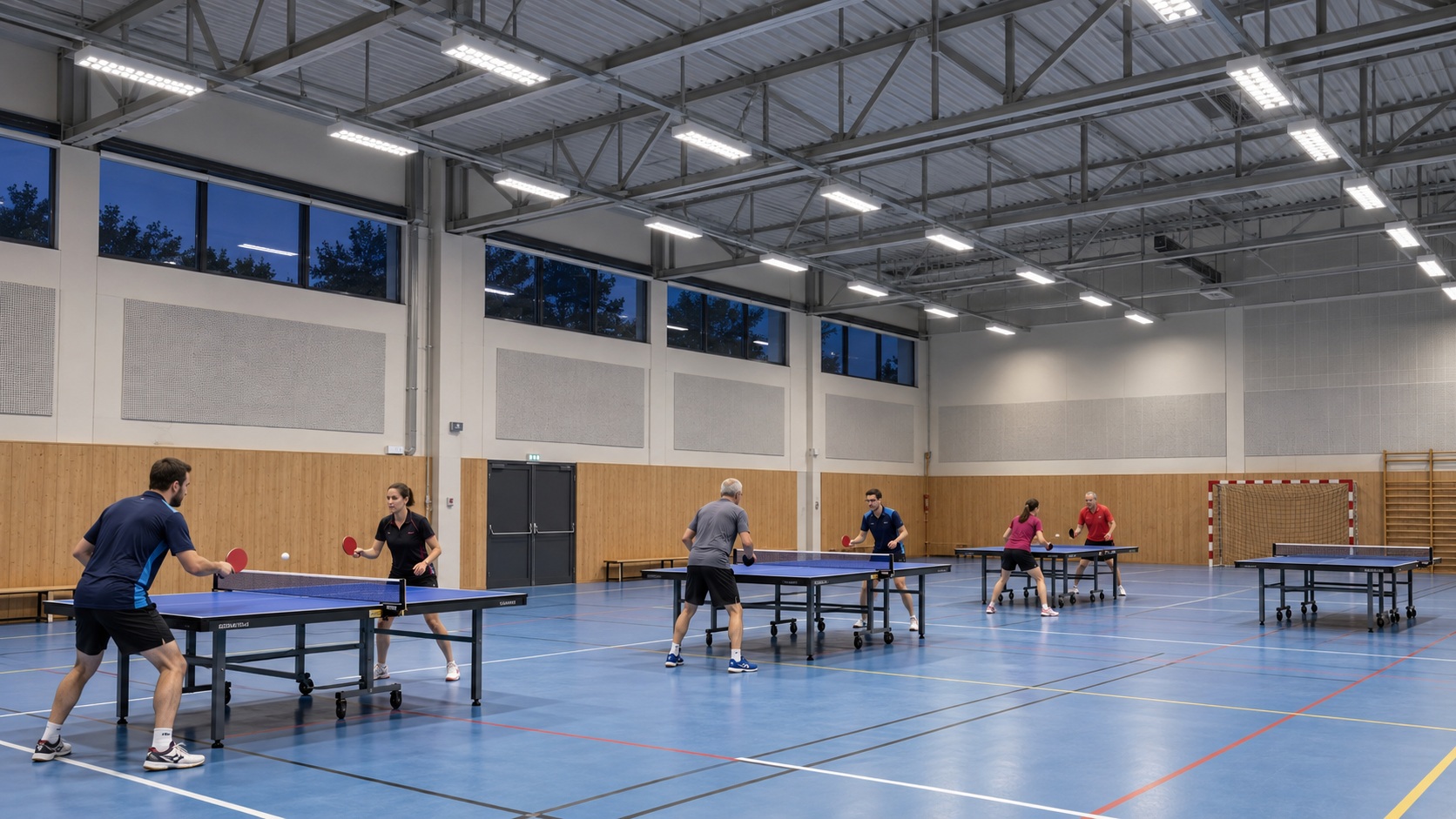
| Table tennis Indoor | 300 lux NF EN 12193 · Class III | 500 lux NF EN 12193 · Class II | 500 or 750 lux FFTT Depending on the required federation classification. | 800 lux Pro 1 000 lux With TV production. FFTT | U0 ≥ 0,70 FFTT | Plane at +0.76 m FFTT Height of the upper surface of the table. No fixed federation number of points was identified in the documents reviewed. | Light sources ≥ 4.50 m FFTT |
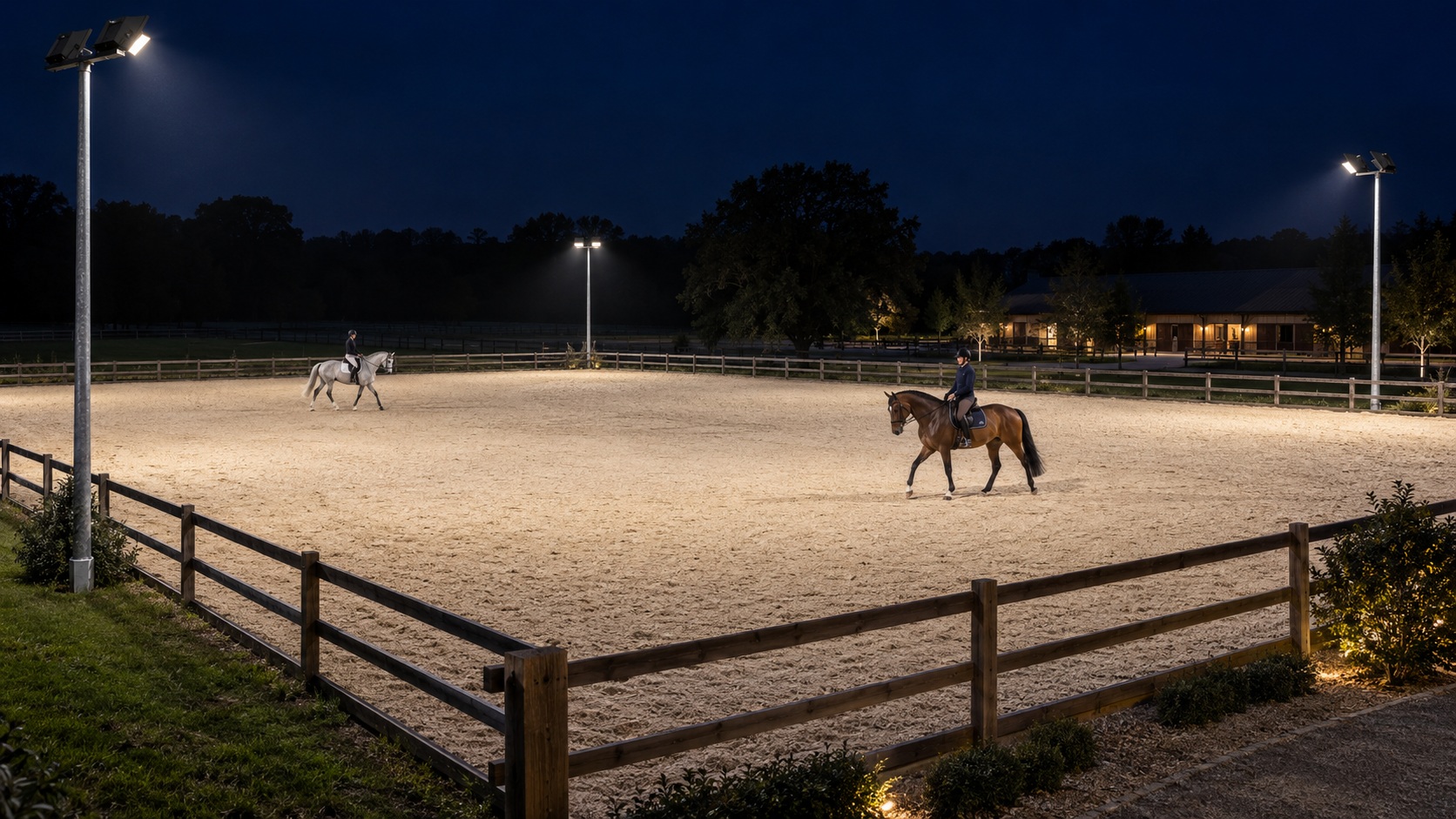
| Equestrian sports Indoor arena / outdoor arena | Indoor arena: 200 lux Outdoor arena: 100 lux NF EN 12193 · Class III | Indoor arena: 300 lux Outdoor arena: 200 lux NF EN 12193 · Class II | 500 lux NF EN 12193 · Class I | Depending on the discipline Event specifications | Depending on class NF EN 12193 Uniformity must be included in the project study. | Appropriate grid NF EN 12193 Horizontal average over the reference area. | Depending on the site Indoor arena: structure and height. Outdoor arena: poles, setbacks, glare and surroundings. |
| Badminton Indoor | 300 lux FFBaD + NF EN 12193 Training / Class III. | 500 lux FFBaD + NF EN 12193 Regional / Class II. | 750 lux FFBaD + NF EN 12193 National / Class I. | BWF specifications International | U0 ≥ 0,70 FFBaD + NF EN 12193 Emin / Emax ≥ 0,50 is also required in the FFBaD reference framework. | 10 points FFBaD Measurements at +1.00 m above floor level. | Luminaires outside the playing area FFBaD The perception of high trajectories also requires careful control of the illuminated volume. |
| Multi-sport court Outdoor multi-sport | 100 to 250 lux STADÉLUM target depending on use | 300 to 500 lux STADÉLUM target depending on use Depending on use and the sports played. | Depending on main sport Corresponding Class I | Cannot be generalised Specific specifications | U0: 0,50 to 0,70 At regional level, depending on use and the sports actually played. | At ground level Grid adapted to the dimensions of the multi-sport area. | Depending on surroundings Surroundings, setbacks, poles, access, glare and spill light. |
Classes I, II and III of NF EN 12193 do not automatically correspond to a French sports division. When a federation explicitly adopts the standard, the dual reference is indicated. In all other cases, the two classifications remain separate.
AN ESSENTIAL DISTINCTION
The measurement plane is not always at ground level
The height at which lux levels are calculated or measured can affect the result. It must therefore be defined before starting the photometric study.
Horizontal measurement using the FFF federation grid.
FFT measurement over 24 points.
13-point FFT grid: all points at ground level except point no. 7, measured at net height.
Measurement over 10 points at 1 m above the playing area.
Measurement over 13 points at ground level.
14 points according to the FFHandball federation procedure.
Height of the upper surface of the table.
Specific FFBaD measurement over 10 points per court.
UNDERSTANDING THE MEASUREMENT
13, 14 or 24 points: the final value is still an average
The number of points defines the sampling method for the playing area. The measured values are then used to calculate average illuminance and uniformity.
Understanding the measurement
13, 14 or 24 points: the final value is still an average
The number of points defines the sampling method for the playing area. The measured values are then used to calculate average illuminance and uniformity.
STADÉLUM method
The table defines the target. The study builds the solution.
A regulatory level does not define the number of luminaires, their power or their optics. These elements depend on the site's dimensions and actual layout.
Identify the target
Level of play, federation classification, applicable standard or competition specifications.
Analyse the site
Dimensions, roof structure, poles, mounting points, surroundings and existing installations.
Use the correct grid
The calculation plane and number of points must correspond to the sport being assessed.
Select the optics
The right light distribution directs useful luminous flux where it is actually needed.
Check visual comfort
Uniformity, glare, sightlines, trajectories and stray light are checked.
Optimise power
The aim is to achieve the required result without unnecessarily increasing the number of luminaires or watts.
SPORTS LIGHTING PRELIMINARY STUDY
Before pricing the luminaires, let's assess the project.
Two sports areas targeting exactly the same lux level may require completely different configurations depending on their height, layout and surroundings.
Send us the sport, dimensions, target level, available heights, existing layout and a few photos or plans. This information allows us to prepare an initial technical assessment.
Request a preliminary studyThis summary is a technical guidance tool. Federation regulations, NF EN 12193 and competition specifications may change or differ depending on the level of competition. The applicable reference must therefore be verified before final approval of a project.